



THE HeRO GRAFT DIFFERENCE
HeRO Graft (Hemodialysis Reliable Outflow) is the ONLY fully subcutaneous AV access solution clinically proven to maintain long-term access for hemodialysis patients with central venous stenosis. HeRO Graft is classified by the FDA as a graft, but differs from a conventional AV graft since it has no venous anastomosis. It consists of two primary components:
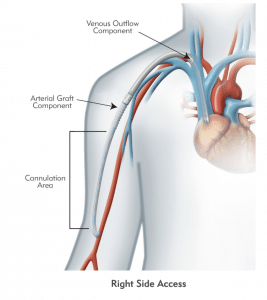
A Proprietary ePTFE Arterial Graft Component
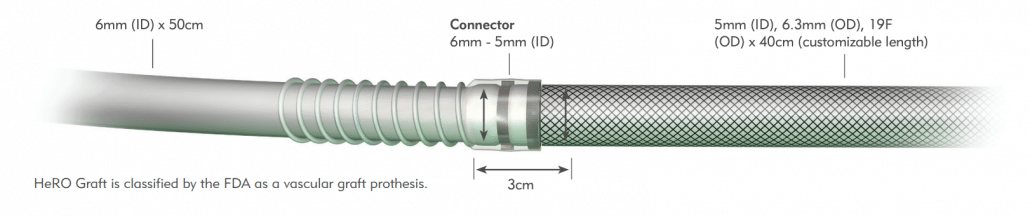
The HeRO Graft Arterial Graft Component has a 6mm inner diameter (ID), 7.4mm outer diameter (OD), and is 53cm long, inclusive of the connector. It consists of an ePTFE hemodialysis graft with PTFE beading to provide kink resistance near the proprietary titanium connector. The titanium connector attaches the Arterial Graft Component to the Venous Outflow Component. The Arterial Graft Component is cannulated using standard technique according to KDOQI guidelines.
A Proprietary ePTFE Venous Outflow Component
The HeRO Graft Venous Outflow Component has a 5mm ID, 19F (6.3mm) OD, and is 40cm long. It consists of radiopaque silicone with braided nitinol reinforcement (for kink and crush resistance) and a radiopaque marker band at the distal tip.
See the HeRO Graft Instructions for use.
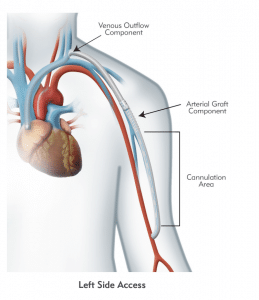
ePTFE Graft with Connector
- Beading (3-4cm) for kink resistance
- Orientation line on graft to guide placement during tunneling
- Titanium connector
Silicone-Coated Nitinol Component
- No venous anastomosis
- Reinforced 48 braid nitinol: kink & crush resistant
- Removable and replaceable Radiopaque band (at distal tip) integrated within the silicone
References
- Initial Experience and Outcome of a New Hemodialysis Access Device for Catheter-Dependent Patients.Howard E. Katzman, Robert B. McLafferty, John R. Ross, Marc H. Glickman, Eric K. Peden and Jeffrey H. Lawson. JVS, Journal of Vascular Surgery, September 2009 Volume 50, Issue 3, Pages 600-607.e1
- Gage et al., EJVES 2012.
- Dageforde et al., JSR 2012.